Prime Intellect Raises $130M Series A at $1B Valuation to Power Enterprise AI Agents
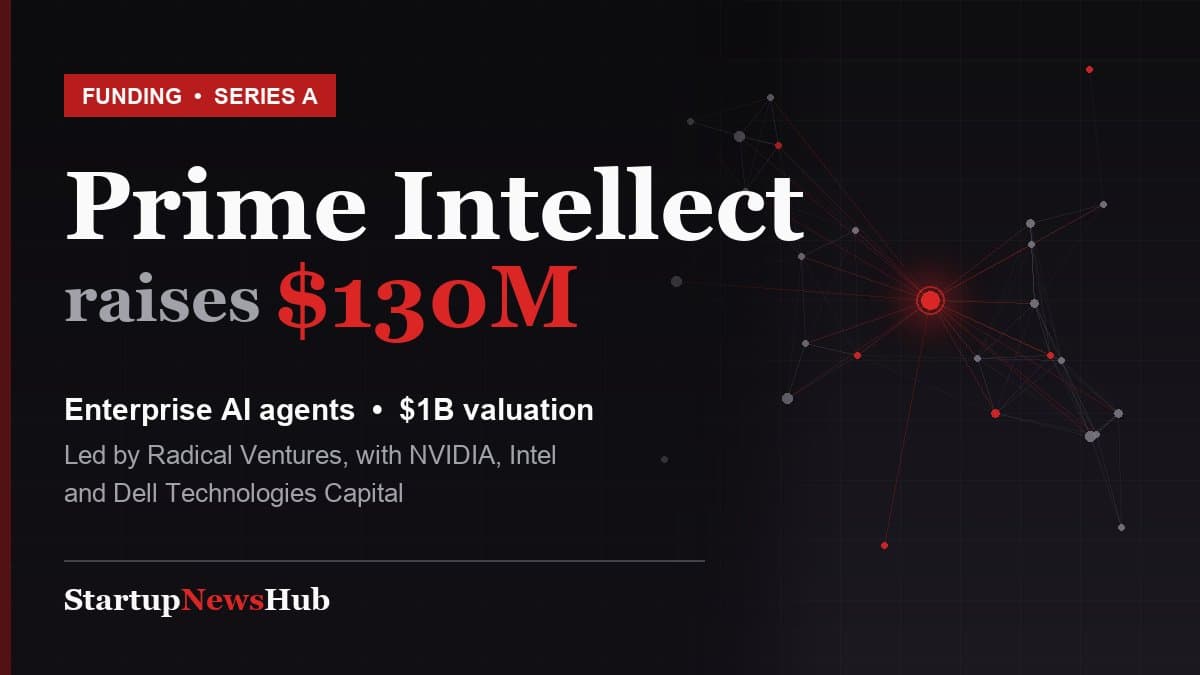
Prime Intellect, the startup helping enterprises train their own AI agents instead of renting intelligence from frontier labs, has raised a $130 million Series A at a $1 billion valuation. The round was led by Radical Ventures, with participation from an unusually strategic bench of backers: NVIDIA Ventures, Intel Capital, Dell Technologies Capital, and Iconiq.
The raise brings Prime Intellect's total funding to more than $150 million — remarkable velocity for a company founded only in 2024, and one of the clearest signals yet that enterprise AI agents have moved from experiment to line item.
What Prime Intellect Does
Prime Intellect sells the picks and shovels for AI agent training: computing infrastructure, an open-source reinforcement learning platform, and evaluation tools that let companies build agents tuned to their own workflows and data. Rather than an all-or-nothing suite, its marketplace model lets customers pick the specific components they need.
The pitch resonates for a simple reason — dependence. Most enterprises today rent their intelligence from a handful of frontier AI labs, with all the data-privacy exposure, pricing risk, and roadmap dependence that implies. Prime Intellect's bet, led by CEO and co-founder Vincent Weisser, is that serious companies will increasingly want to train their own AI models and agents — the same way they eventually stopped outsourcing their core software.
Traction: $100M Run Rate in Under Two Years
The numbers behind the round explain the billion-dollar price tag. Prime Intellect has hit an annualized revenue run rate of $100 million, with paying customers including Ramp, Zapier, and Flapping Airplanes using its hosted platform.
Ramp's case is the flagship example: the fintech built an agent on Prime Intellect's tooling that the company says beat frontier-model performance on accuracy while running faster and at substantially lower cost. That's the argument for the whole category in one sentence — custom-trained agents that outperform rented ones on the tasks a business actually cares about.
The angel list reads like a who's-who of the agent economy: Aravind Srinivas (Perplexity), Aaron Levie (Box), Winston Weinberg (Harvey), Jeff Wang (Cognition), and Brendan Foody (Mercor) all participated.
Why the Strategic Investors Matter
It's hard to miss that three of the four biggest names on the cap table — NVIDIA, Intel, and Dell — are the companies selling the hardware that AI agent training runs on. Their participation is a bet that enterprise demand for training infrastructure keeps compounding, and it gives Prime Intellect privileged access to the scarcest resource in AI: compute.
For Radical Ventures, the AI-focused firm leading the round, it's a doubling-down on the thesis that the next layer of AI value accrues to whoever owns the training and evaluation stack for enterprise AI agents — not just the models themselves.
The Bigger Picture: Agents Are Eating July's Funding News
Prime Intellect's round caps a week in which agentic AI dominated startup funding. Norm AI closed a $120M Series C led by Khosla Ventures for AI compliance agents in regulated industries, Taktile raised a $110M Series C led by Goldman Sachs Growth for agentic decisioning in banks and insurers, and Ollama — the open-source tool for running models locally — landed a $65M Series B as its developer base neared 9 million.
The through-line investors keep repeating: capital is concentrating in AI infrastructure and agents deployed in high-stakes, regulated workflows, while thin "AI wrapper" startups struggle to raise. With U.S. startups having raised roughly $406 billion so far in 2026, the money is clearly still flowing — it's just flowing to companies that own their stack, their data, and increasingly, their own agents.
Source: TechCrunch
More in Funding
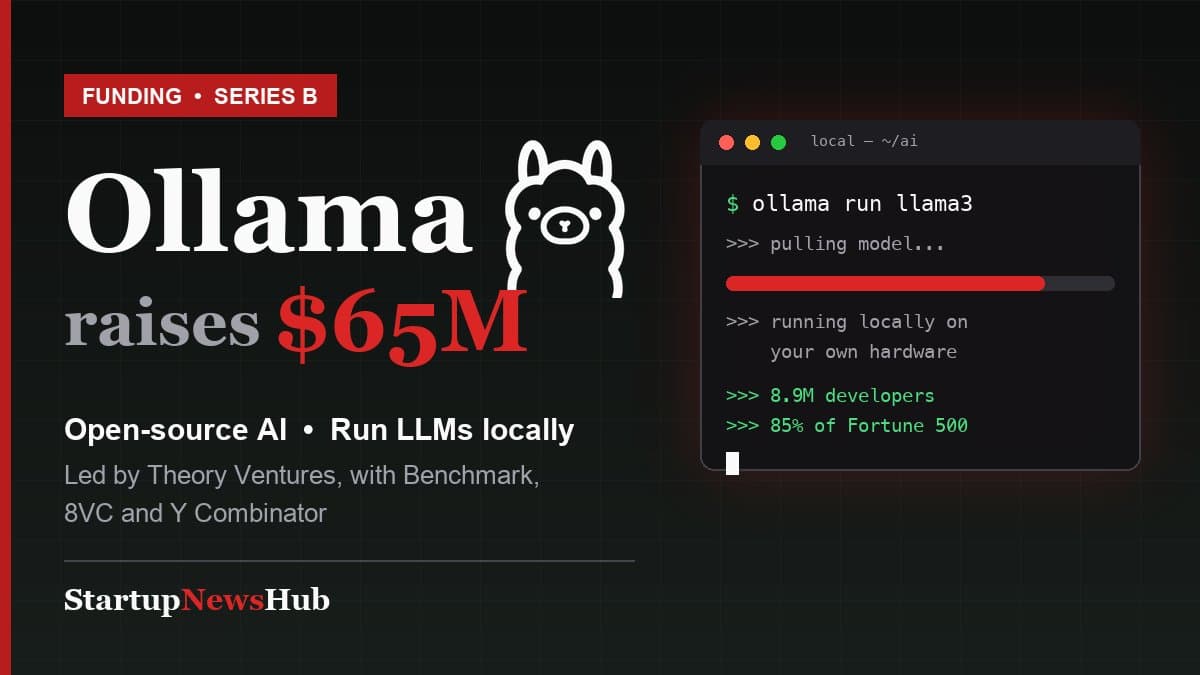
Ollama Raises $65M Series B to Grow Its Open-Source AI Platform
Ollama closes a $65M Series B led by Theory Ventures, growing to 8.9M developers running open AI models locally — bringing its total funding to $88M.